Wednesday, April 2, 2014

Children get sick more easily with unpredictable spring temperatures 春天乍暖還寒 兒童易染病


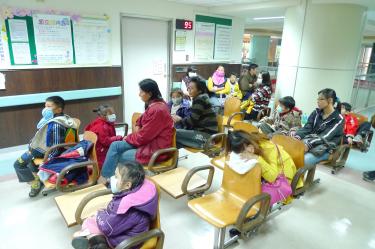
Above and below: Children and parents wait in the pediatrics department of a hospital in Greater Taichung on Jan. 2.
兒童與家長一月二日在台中市一所醫院的小兒科候診。

photos: Tsai Shu-yuan, Liberty Times
照片:自由時報蔡淑媛

It is easier for children to get sick in the spring due to highly unpredictable weather and temperatures as well as children’s lower resistance to infection. Chang Tao-tse, a pediatrician at Miaoli County’s Da Chien General Hospital, says there have been many cases of colds, bronchitis, mycoplasma pneumonia, and croup recently. He reminds parents to pay more attention when a child is not feeling well and to seek immediate medical attention.
Chang says that the common cold is the most frequently seen illness among children in the springtime. Usually a cold passes simply by drinking more water and resting, but if a high fever persists there is the possibility that it will bring about tympanitis or sinusitis. Parents and teachers should teach children to wash their hands often, avoid visiting public places, and wear masks if they do have a cold so that the virus does not continue to spread.
Also common in the spring is bronchitis, the initial symptoms of which resemble the common cold — coughing and a runny nose, but usually the patient recovers in one to two weeks. High fevers and labored breathing occur in serious cases, possibly leading to hypoxia, which requires hospitalization and is a situation that must be taken very seriously.
Chang says that mycoplasma pneumonia is often seen in school-aged children. Its initial symptoms include headaches, fever, sore throat, and lethargy. After two to five days, coughing begins, and sometimes non-respiratory symptoms such as vomiting, abdominal pains, conjunctivitis, and skin rashes also appear.
Croup occurs when a child’s voice suddenly becomes hoarse, with a “barking” cough, stridor, and breathing difficulties, during which time parents usually do not know what to do. Chang says the symptoms of croup usually appear late at night or early in the morning. Breathing warm steam can mitigate the symptoms, but it must not be taken lightly in cases of epilottitis, high fevers, short-temperedness or difficulty swallowing, or if it leads to an acute obstruction of the airways.
Other illnesses that are frequently seen in the spring include chicken pox, enterogastritis, allergic rhinitis, atopic dermatitis, and enteroviruses. Some viruses are picked up at school, so teachers must also help in protecting children’s health by letting parents know when a child is not feeling well and arranging for them to see a doctor.
(Liberty Times, Translated by Kyle Jeffcoat)


春天氣候多變、乍暖還寒,兒童的抵抗力比較弱,因此容易生病,苗栗大千綜合醫院小兒科醫師張濤澤表示,最近常見的有感冒、支氣管炎、黴漿性肺炎與哮吼等,請家長多留意,發現孩子身體不適應趕快就醫。
張濤澤指出,感冒是兒童在春季最常見的流行疾病,一般感冒只需多喝水、多休息,但如果高燒不退,有可能併發中耳炎、鼻竇炎等,家長、老師應教導小朋友勤洗手,避免出入公共場所,如果感冒應戴上口罩,以免擴大傳染。
支氣管炎也好發於春天,初期症狀像感冒,有咳嗽、流鼻水,大多數一到二週可痊癒,但病情嚴重時會合併高燒與嚴重的呼吸窘迫、甚至缺氧,必須住院治療,不可不慎。
他表示,黴漿性肺炎常見於學齡期的兒童,初期症狀包括頭痛、發燒、喉嚨痛、全身無力,二到五天後出現咳嗽,有時也會有嘔吐、腹痛、結膜炎與皮膚疹等非呼吸道方面的症狀。
哮吼是指幼兒突然聲音沙啞、咳嗽像狗吠聲,吸氣有喘鳴聲及呼吸困難,常讓家長們不知所措。張濤澤說,哮吼常發生在夜間和清晨,吸入濕熱的蒸氣可減輕症狀,但如果併發細菌性會厭炎,會出現高燒、煩躁、吞嚥困難,甚至持續惡化阻塞氣道,不能大意。
兒童在春季的常見疾病還包括水痘、腸胃炎、過敏性鼻炎、異位性皮膚炎、腸病毒等,有些疾病是在學校被同學感染造成,因此小朋友的健康也需要老師協助守護,發現學童身體不適應立即家長反映,安排就診。 (自由時報記者傅潮標)


TODAY’S WORDS 今日單字
1. pediatrician n.
小兒科醫師 (xiao3 er2 ke1 yi1 shi1)
例: Your child should see a pediatrician instead of a family doctor if they have a complex medical issue.
(如果你的孩子有比較複雜的醫療問題,應該看小兒科醫師不是家庭醫師。)
2. hoarse adj.
沙啞的 (sha1 ya3 de5)
例: The coach’s voice was very hoarse after yelling at the players during the game.
(教練因為比賽時對球員喊叫,聲音變沙啞。)
3. chicken pox n. phr.
水痘 (shui3 dou4)
例: Chicken pox usually occurs during childhood and is highly contagious.
(水痘通常好發於孩童時期,且傳染性頗高。)


Resources:
http://www.indiaparenting.com/alternative-healing/12_4039/yoga-for-improving-immunity.html
http://www.ndtv.com/video/player/yogasutra/yoga-to-build-immunity/214995

Tuesday, February 4, 2014

How to avoid putting on the pounds over the Lunar New Year 過年狂吃 近半民眾胖了一點七公斤


A doctor holds a plate of food from a suggested meal for diabetics at a hospital in Greater Taichung on Jan. 17.
一位醫師一月十七日於台中一所醫院推薦適合糖尿病患食用的年菜。

Photo: Tsai Shu-yuan, Liberty Times
照片:自由時報記者蔡淑媛

The number of calories in a Lunar New Year’s Eve meal is exorbitant. One meal could have up to 1,880 calories, meaning you would have to jog for more than two hours to burn them off. After a nine-day holiday filled with languidness and gluttony, as well as gourmet meals, cold weather and the desire to stay sedentary, roughly 45 percent of us will still be surprised to find that we have gained around 1.7kg.
年菜熱量超高,吃一餐熱量高達一千八百八十大卡,得跑步兩小時以上才能消耗掉。美食加上天冷、人不愛動,經過連續九天懶洋洋、放肆口慾的假期生活,百分之四十五民眾過完年才驚覺胖了一點七公斤。
The Bureau of Health Promotion under the Department of Health estimates that a takeaway Lunar New Year’s Eve meal consisting of six courses can have as many as 11,000 calories. Even if six people share the meal, each person would consumer up to 1,880 calories. An adult who weighs 60kg actually only needs 600 calories per meal, so a typical New Year’s Eve meal is equal to three regular meals. If one eats like this every day over the holiday, it would be nearly impossible not to gain weight.
衛生署國健局估計,一套六道的外帶年菜,總熱量高達一萬一千多卡,就算六個人分食一餐,每人也攝取高達一千八百八十大卡。其實一個體重六十公斤的成年人,每餐吃六百大卡就夠了,年菜一餐熱量可抵三餐,年假期間天天這樣吃,想不胖也難。
For the survey, the bureau interviewed more than 1,000 adults over the age of 18 by telephone. Around 45 percent of them said they gain weight during the Lunar New Year — 1.7kg on average.
國健局是以電話調查全國一千多位十八歲以上成年人發現,近四成五民眾過完年體重增加,平均胖一點七公斤。
Bureau of Health Promotion Director-General Chiou Shu-ti proposes four New Year’s meal tricks, including the labeling, ingredients, cooking and the staple foods for a Lunar New Year’s Eve meal for people to follow. First, prior to buying food for your New Year’s Eve meal, be sure to look at the calories listed on labels, and then purchase the amount of food according to the number of people in your household. Chiou also suggests replacing fatty meats with lean meats, eating seafood instead of red meat, and when it comes to how the foods should be cooked, she recommends steaming, stewing, heating in hot water, or eating cold foods dressed with sauce instead of fried foods. For staples, she says that grain rice or steamed turnip cakes should be used instead of glutinous oil rice.
國健局局長邱淑媞針對年菜標示、食材、煮法、主食,提出四大年菜秘訣供民眾參考。首先,選購年菜前應看清熱量標示,依家中人數估算購買量。以瘦肉取代肥肉、海鮮取代紅肉;烹調方式以清蒸、滷、燙、涼拌取代油炸;主食部分則建議以五穀飯或蒸蘿蔔糕取代油飯。
Nutritionist Huang Li-ting says that by following the principles outlined above, you can significantly decrease the amount of calories in a meal without changing the portions and eat your fill without having to worry about gaining weight. The amount of vegetables included in readymade New Year’s Eve meals is also insufficient, so Huang suggests preparing extra veggies to increase the amount of fiber and one’s overall feeling of satisfaction.
營養師黃莉婷表示,依照前述原則設計的菜單,可以大幅降低同樣份量的菜餚熱量,吃得飽又不怕胖。同時外購年菜的蔬菜量普遍不足,建議可額外預備新鮮蔬菜,可以增加膳食纖維,又能增加飽足感。
For smaller households, Huang suggests dividing the meal into smaller portions and only heating up just the right amount of leftovers to avoid overeating. When getting together for a chat, she also suggests eating fresh fruit as a snack along with hot sugarless tea to replace sugary drinks, allowing you to avoid consuming too many calories.
(Liberty Times, Translated by Kyle Jeffcoat)
如果家中人口不多,黃莉婷建議,可以先把年菜分裝成小份量,每次加熱一份剛好的份量,就不怕吃得太撐。團聚聊天時,最好用新鮮水果取代零食,無糖熱茶取代含糖飲料,就能輕鬆避免熱量破表。
(自由時報記者邱宜君)
This story has been viewed 1714 times.

  1. Yoga for weight loss

    Watch Yoga for weight loss Video on NDTV.com. Today obesity is a serious and growing public health problem ...http://www.ndtv.com/video/player/yoga-city/yoga-for-weight-loss/227114

Wednesday, January 8, 2014

Top 10 habits that make you susceptible to sickness 致病十惡習 久坐久站最常犯

Happy New Year! 新年快樂!

A doctor poses with a patient wearing a neck brace after injuring her neck from looking down at her smartphone too often at a hospital in Greater Tainan on Dec. 25 last year.
去年十二月二十五日在台南一間醫院,一名醫師與一名因低頭看智慧型手機太頻繁導致頸部受損而戴頸圈的女子合照。

Photo: Meng Ching-tzu, Liberty Times
照片:自由時報記者孟慶慈

Being sedentary, not drinking enough water and staying up late at night are just a few of the 10 worst habits that can make you susceptible to falling ill. How many do you have? The results of the latest version of a national survey on people’s living habits show that 20-somethings in Taiwan have the worst living habits of all, including staying up late, being sedentary, eating foods with high caloric content, regularly keeping their heads down to look at electronic devices and using computer devices in bed before falling asleep.
Chen Liang-kung, director of the Center for Geriatrics and Gerontology at Taipei Veterans General Hospital, says that such poor living habits can increase one’s risk of cardiovascular disease, metabolic disorders, neck and spine disorders and mental deterioration. Chen recommends changing bad habits while you are still young, like setting an alarm clock to remind you to stand up and move around for three to five minutes every hour, putting your cellphone far away during sleep, and limiting the amount of high-calorie foods you eat.
A health magazine published by cable news station TVBS conducted the survey by telephone in October, interviewing 1,092 people over the age of 15.

The survey found that the number one bad habit among Taiwanese is being sedentary and standing too long, with around 72 percent of respondents saying they have this problem. Drinking less than a liter of water every day came in at second (33 percent), followed by habitually putting one’s cellphone next to the pillow while sleeping (33 percent), not exercising (30 percent), often lowering one’s head to use an electronic device like a cellphone or tablet computer (30 percent), drinking at least one sugary drink every day (30 percent), frequently crossing one’s legs (30 percent), eating high calorie foods at least twice a week (25 percent), using a mobile device like a cellphone or tablet computer in bed before sleep (24 percent), and sleeping less than six hours every night (21 percent) respectively.
Getting inadequate sleep for an extended period of time affects the autonomic nervous system and can lead to high blood pressure, as well as increasing one’s risk of high stress and irregular heartbeat, Chen says. People who get less than six hours of sleep every night should try going to bed 15 minutes earlier and taking afternoon naps for 30 minutes.
To get rid of these bad habits which can lead to illness, Chen recommends taking a gradual approach to change. For example, people who do not exercise at all can try getting off the bus one or two stops earlier. People who drink sugary drinks every day can try taking half the amount of sugar instead of the full amount, and eventually no sugar. People who do not drink enough water should force themselves to drink 500cc of water right after waking up, and again in the morning and in the afternoon, he says.
(Liberty Times, Translated by Kyle Jeffcoat)


十大致病壞習慣「久坐」、「不愛喝水」、「熬夜」,你有幾個呢?最新公佈的「國人生活習慣大調查」結果發現,台灣二十至二十九歲的年輕人,生活習慣最不好,包括「熬夜」、「久坐」、「吃高熱量食物」、「長期低頭用3C產品」,以及「睡前還在床上用電腦」等。
台北榮總高齡醫學中心主任陳亮恭指出,這些不良生活習慣,可能加速心血管疾病、代謝疾病、頸椎病變以及心智退化等,建議趁年輕改掉壞習慣,不妨設定鬧鐘、每小時站起來活動三到五分鐘;睡覺時將手機放遠;限定自己吃高熱量飲食頻率等。
這項調查由《健康兩點靈雜誌》於今年十月間、針對全台一千零九十二位、十五歲以上民眾進行電話訪問。
調查發現,國人最常見的生活惡習第一名就是「經常久坐或久站」,共有百分之七十二民眾有此問題;其次依序為:「每天喝水不足一千cc(百分之三十三)」、「睡覺時,習慣將手機放在枕頭旁邊(百分之三十三)」、「完全不運動(百分之三十)」、「常低頭使用手機或平板電腦等3C產品(百分之三十)」、「每天至少喝一杯以上含糖飲料(百分之三十)」、「經常翹腳(百分之三十)」、「每週有兩天以上吃高熱量食物(百分之二十五)」、「睡前躺在床上使用手機、平板電腦等3C產品(百分之二十四)」以及「每天睡覺都不足六小時(百分之二十一)」。
陳亮恭指出,長期睡眠不足不僅影響自律神經,還可能有相對高血糖問題,甚至因壓力大、心律不整等風險也高,睡眠不足六小時者不妨試著每天提早十五分鐘上床,午睡補眠半小時。
要遠離這些致病壞習慣,陳亮恭建議,可以採循序漸進的改變。例如,完全不運動的人可以試著提早一、兩站下公車;或每天喝含糖飲料的人,從全糖改成半糖,然後變成無糖;水分攝取不足的人應規定自己在起床、上午、下午時各喝五百cc水。


Resources:
Freedom From Resistance
http://www.yogajournal.com/practice/2580

Saturday, November 30, 2013

Yoga for Knee Damage 運動過度損軟骨 引發髕股骨關節炎


Seniors participate in a sports meet in Chiayi County on May 25.
老人五月二十五日於嘉義縣參加運動會。

Photo: Tsai Tsung-hsun, Liberty Times
照片:自由時報記者蔡宗勳

Peng is a 52-year-old man who has been ardently in love with exercising since he was a child. Aside from boxing, he also enjoys running and mountaineering. Half a year ago his knees started swelling and changing shape, but painkillers and hyaluronic acid did not help. Eventually he also began experiencing unbearable pains in his lumbar region and back, so he decided to see an orthopedist, who diagnosed that the cartilage in his knees was severely damaged and had caused patellofemoral arthritis.
Liu Hwa-chang, a doctor in the orthopedic surgery department at Taiwan Adventist Hospital, says that 80 percent of people over the age of 65 in Taiwan have degenerative arthritis in their knees, and that with the decrease in temperatures during autumn and winter, the knees will make crackling sounds while moving, particularly when going up and down stairs, getting up or squatting on the toilet. Not only is the pain unbearable, but in some serious cases the knee also changes shape. Degenerative arthritis is not limited to seniors. Clinical studies show that many people in their 40s and 50s suffer from the condition from being obese, excessive exercise, moving heavy objects or wearing high heels too often. If the kneecaps endure heavy weight for an extended amount of time it causes damage to cartilage, which can lead to arthritis or patellofemoral pain syndrome (PFPS).

If overused, the patella, commonly known as the kneecap, can do harm to posterior cartilage and cause pain. Clinical studies show that people often go to the doctor due to pain in the kneecaps, but X-rays do not show anything. Orthopedists must first eliminate whether any abnormalities in the anterior or posterior joints exist and check to see if the joints of the kneecap are slanted or turning outward before determining if the patient has patellofemoral arthritis.
TODAY’S WORDS 今日單字
1. ardently adv.
熱心地;熱烈地 (re4 xin1 de5; re4 lie4 de5)
例: Russian President Vladimir Putin is ardently anti-Western.
(俄羅斯總理佛拉迪米爾‧普廷熱烈反對西方。)
2. unbearable adj.
難以忍受的 (nan2 yi3 ren3 shou4 de5)
例: The cost of living in this city has become an unbearable burden.
(住這城市的費用已成為難以忍受的負擔了。)
3. abnormality n.
反常;異常;變態 (fan3 chang2; yi4 chang2; bian4 tai4)
例: Engineers are checking for any abnormalities in the new system.
(工程師在檢查新系統是否有任何異常之處。)
Aside from using conservative therapy to treat patellofemoral arthritis, strengthening quadricep muscles and losing weight can also be used. If a doctor’s evaluation permits, the use of surgery might also be considered.
(Liberty Times, Translated by Kyle Jeffcoat)
五十二歲的彭先生從年輕時就酷愛運動,除了打拳擊外,也喜歡跑步及爬山,半年前雙腳膝蓋出現腫脹、變形,吃止痛藥及打玻尿酸都無效,最後腰背疼痛難耐,到骨科就醫,經診斷為膝蓋軟骨嚴重磨損,引起髕股骨關節炎。
台安醫院骨科醫師劉華昌表示,台灣六十五歲以上老年人有八成罹患退化性膝關節炎,每到秋冬氣溫下降時,膝蓋活動時,就喀喀作響,尤其在上下樓梯、起身或蹲廁所時,不但疼痛難耐,嚴重者還會變形,但退化性關節炎不是老年人的專利。臨床上,常見許多四十到五十歲患者因肥胖、過度運動、搬重物或經常穿高跟鞋,膝蓋長期飽受過度承重造成軟骨磨損,引發關節炎或髕骨疼痛。
劉華昌指出,「髕骨」就是俗稱的「膝蓋骨」,長期過度使用會造成外側軟骨磨損,引起疼痛。臨床上,常見患者因膝蓋疼痛就醫,照了X光卻查不出問題。骨科醫師會先排除內、外側關節面異常問題,並檢查患者的髕股骨關節是否出現傾斜或外翻,以診斷患者是否罹患髕股骨關節炎。
髕股骨關節炎患者的治療除了採保守治療,藉由強化四頭肌力量強度及減重方式減緩外,若經醫師評估許可,可考慮手術治療。
(自由時報記者魏怡嘉)

Dynamic Warm Up

  • 3 weeks ago
  • 2,141 views
We spend a lot of time learning how to exercise, but now we are going to learn how to prepare for a workout. Today on XHIT, fitness trainer Rebecca-Louise shows you how to engage your whole body in...

Friday, October 4, 2013

Healing Yoga after an Earthquake 地震過後的治療性瑜珈

Taiwan’s first earthquake prediction park opens 台灣首座地震前兆觀測園區成立

Eastern Taiwan Earthquake Research Center director Chang Wen-yen gestures in front of earthquake prediction facilities in Hualien County on Sept. 24.
台灣東部地震研究中心主任張文彥九月二十四日在花蓮縣的地震觀測站前留影。

Do earthquakes provide any identifiable precursors? Recent research into thermal infrared and gamma radiation conducted by Lee Lou-chuang, acting director of Academia Sinica’s Institute of Earth Sciences and Minister of the National Science Council (NSC), may offer new clues for predicting earthquakes.
The NSC, the Central Weather Bureau and the National Center for Research on Earthquake Engineering have teamed up in establishing the nation’s first Experimental Earthquake Prediction Observatory Park as part of the newly opened Eastern Taiwan Earthquake Research Center (E-TEC) at National Dong Hwa University. E-TEC convener Ma Kuo-fong says that he hopes earthquake prediction capabilities can be achieved as soon as possible in order to better meet disaster prevention needs.
Lee’s research found that prior to an earthquake, the formation of steam occurs, along with the release of radon and an increase in infrared rays, all of which are brought on by pressure from tectonic plates. On March 29 this year, Lee discovered that an unusual increase in infrared rays occurred in the ocean off the coast of Taitung, which was followed by an earthquake on March 31 with a magnitude of 6.2 on the Richter scale. Four earthquake detection stations are currently set up at National Chung Cheng University in Chiayi County, in Pingtung County’s Kenting area, on Yangming Mountain in Taipei and at Hualien’s Dong Hwa University.
(Liberty Times, Translated by Kyle Jeffcoat)


地震發生是否有跡可循?國科會主委及中研院地科所所長李羅權最新研究熱紅外線與γ輻射偵測,可望為地震預測提供新線索。
國科會、氣象局、國家地震工程研究中心等共同在東華大學建置「台灣東部地震研究中心」,成立我國首座「地震前兆觀測實驗園區」。東部地震研究中心召集人馬國鳳表示,希望儘速達到地震預測目標,提供防災所需。
李羅權研究發現,地震前受到板塊擠壓,帶動水氣形成、氡氣釋出,紅外線會變多。今年三月二十九日發現台東外海熱紅外線量異常增加,三十一日就發生芮氏規模六點二地震。目前已在嘉義中正大學、屏東墾丁、台北陽明山與花蓮東華大學建置四個觀測點。

TODAY’S WORDS 今日單字
1. precursor n.
前兆;前導;先驅
例: A shift toward tolerance between the two countries is a precursor to peace.
(兩國互相包容的態度乃是和平的跡象。)
2. clue n.
線索 
例: Are there any clues pointing to the cause of the fire? (有沒有起火原因的線索?)
3. unusual adj.
異常的;奇怪的 例: That’s an unusual series of events. You lost your car keys, your car was stolen and then you found your keys.
(那倒是一連串奇怪的事件:你丟了車鑰匙、車子被偷了,最後才找到車鑰匙。)


Sunday, September 22, 2013

Yoga for Shyness害羞的人適合瑜伽

More than 70% of Taiwanese students too shy to ask questions in class 台生愛面子 超過七成上課不願發言


http://www.rediff.com/getahead/2007/jun/04slid1.htm

Why are students so reticent in class? According to a recent study conducted by researchers from National Taiwan Normal University (NTNU), National Tsing Hua University (NTHU) and Taipei Municipal University of Education (TMUE), students are reluctant about asking questions or responding to questions in the classroom because they fear losing face. The study also found that Taiwanese students are culturally conditioned to learn passively, without asking or answering questions verbally.
NTU professor Fwu Bih-jen says that the advantage of Taiwan’s teaching methods is that students learn by memorizing and practicing, which gives them a firm foundation. This competitive edge is most apparent when looking at how Taiwanese students rank in overall educational performance in international evaluations, including the Trends in International Mathematics and Science Study (TIMSS) and the Programme for International Student Assessment (PISA), Fwu says, adding that this advantage also provides capable talent to the original equipment manufacturing (OEM) sector. For the future, however, she says that Taiwan will need more innovators, people who can think critically and analytically. Taiwanese students typically do not perform as well in areas covering these higher cognitive skills in TIMSS and PISA, which explains why they show less overall proficiency in those areas.
The National Science Council commissioned researchers from NTNU, NTHU and TMUE to study university students in the classroom. The results of the study showed that 83 percent of students were accustomed to recitation and rote learning, while only 28 percent were willing to interact with teachers during class and 36 percent were willing to participate in class discussions and ask questions. The main reason for this paucity of participation is ostensibly because Taiwanese students are generally afraid of losing face and because the majority of their past learning experiences consisted of teachers lecturing without students asking questions during class.
Wei Chih-fen, head of TMUE’s Department of Psychology and Counseling, says that the more afraid a student is of losing face, the less inclined that student is to answering questions, but that students are much more willing to ask questions in class if they feel confident that they have a worthy question that could gain them affirmation from teachers and students by showing their potential.
(Liberty Times, Translated by Kyle Jeffcoat)


TODAY’S WORDS 今日單字
1. reluctant adj.
不情願的;勉強的;猶豫的 (bu4 qing2 yuan4 de5; mian2 qiang3 de5; you2 yu4 de5)
例: Diane is reluctant about quitting her job because she’s only been with the company for three months.
(因為在這家公司工作才三個月,黛安不情願辭職。)

2. inclined adj.
想要;有傾向的 (xiang3 yao4; you3 qing2 xiang4 de5)
例: I’m inclined to staying at home. It just started pouring down outside.
(外面剛開始下大雨。我想留在家裡。)

3. confident adj.
有自信的 (you3 zi4 xin4 de5)
例: She’s confident that she will pass the exam.
(她很有自信考試一定能及格。)


  1. Yoga for Confidence: Warrior Poses To Activate Solar Plexus - QiYoga


    Boost your mood, confidence, passion, strength and flexibility with this 5 minute power QiYoga routine. Boost your energy ...

為什麼學生在課堂上總是靜悄悄?原來是怕問到笨問題或答錯問題而「沒面子」!台灣大學師培中心、台北市立教育大學與清華大學共同合作研究發現,我國文化脈絡下的學習模式,「教」的意涵是「上所施,下所效」,不強調提問與回答。
台大教授符碧真表示,我國學習模式的優勢是學生透過記憶及練習,吸收知識,學識基礎扎實,這可從我國學生多次國際學術評比如國際數學與科學成就趨勢調查(TIMSS)及國際學生評量方案(PISA)整體表現優異或可為證,提供了代工所需人力。但未來發展需要創新人才,需要思辨與探究的能力,我國在TIMSS及PISA評比高層次能力表現較差,說明學生這方面的能力較弱。
國科會委託台灣師範大學、清華大學以及台北市立教育大學研究大學生上課情形,發現高達百分之八十三的大學生修課經驗是「記誦與練習」,只有百分之二十八的學生願意在課堂上與老師互動,百分之三十六願意參與課堂討論與發問,主要原因是台灣學生愛面子,且過去的學習經驗多半是老師單方面教授知識,學生沒有在課堂上發言的習慣。
台北市立教育大學心理與諮商學系主任危芷芬表示,學生愈擔心面子問題,回答意願就越低,但若覺得問出好問題,能展現自己潛能獲老師與同儕肯定,回答意願就愈高。
(自由時報記者湯佳玲)


Summer Anger Yoga 火氣 夏令 瑜伽

Hotter temperatures lead to hotter tempers
溫度越高火氣越大


The sun sets behind an iron ore bulk carrier moored at the iron ore loading facility in Port Hedland, about 1,600km north of Perth, Australia on May 30, 2008.
二00八年五月三十日,太陽在一艘從澳洲珀斯往北一千六百公里的黑德蘭港卸貨設備停泊的鐵礦散裝貨船落下。

Photo: Rueters

A big new study says as the world gets warmer, people are more prone to get hot under the collar. Scientists found that aggressive acts like violent crimes and wars become more likely with each added degree.
The research analyzed 60 studies of such things as the historic collapses of empires, recent wars and violent crime rates in the United States. They found a common thread — extreme weather, hot or dry, means more violence.
An author of the study said that when the weather gets bad people tend to be more willing to hurt others. The team of economists even came up with a formula that predicts how much the risk of different types of violence should increase with extreme weather.
In war-torn parts of equatorial Africa, it says, every added degree Fahrenheit or so increases the chance of conflict between groups, rebellion, war and civil unrest by 11 percent to 14 percent.
(Liberty Times)


一份大型的新研究說,隨著世界愈來愈熱,人們也愈來愈容易生氣。科學家發現,氣溫每升高一度,暴力犯罪與戰爭等咄咄逼人的舉動的可能性也隨之增加。
這份研究分析六十份針對歷史上帝國瓦解、近代戰爭與美國暴力犯罪率等的研究成果。他們發現一個共通的線索:極端天氣,不管是極熱或極乾,都代表更多暴力。
研究作者表示,天氣讓壞人們更傾向於傷害他人。這個經濟學家團隊甚至提出一套公式,預測不同種類的暴力隨極端天氣增加的風險有多高。
研究團隊說,在赤道非洲戰亂頻仍地區,溫度每增加華氏一度左右,不同群體間的衝突——叛亂、戰爭與內亂——的機率,也會增加百分之十一到百分之十四。
(自由時報/翻譯:國際新聞中心)


TODAY’S WORDS 今日單字
1. prone adj.
傾向於;易於 (qing3 xiang4 yu2; yi4 yu2)
例: I’ve always been prone to headaches.
(我容易頭痛。)

2. hot under the collar idiom
發怒的;尷尬的 (fa1 nu4 de5; gan1 ga4 de5)
例: When I suggested he was mistaken he got rather hot under the collar.
(當我暗示他錯了的時候,他相當生氣。)

3. come up with v. phr.
提出某種想法或計畫 (ti2 chu1 mou2 zhong3 xiang2 fa3 huo4 ji4 hua4)
例: She’s come up with some amazing schemes to double her income.
(她提出一些讓自己收入倍增的驚人計畫。)


Grammar語法


名詞 Noun

動詞 Verb

形容詞 Adjective

慣用語 Idiom